Interactive website for an AI company: Libra AI
libramli.ai (opens in new tab)
Libra AI Technologies · website design, UX and build · December 2019 – March 2020 · still online, run by their own team
Their old site spoke to researchers, not to businesses
Libra AI Technologies designs, builds and deploys custom AI systems for businesses, across generative and agentic AI, machine learning, computer vision, data engineering and advanced analytics. Until 2019, as Libra MLI, they had a one-page website written in very technical language. The service descriptions were accurate, but even the prospective client who needs Libra often doesn't know the terms, or what Libra's services could do for them. The new site set out to change exactly that, or, as Libra puts it: "We do not design our dashboards for data analysts."
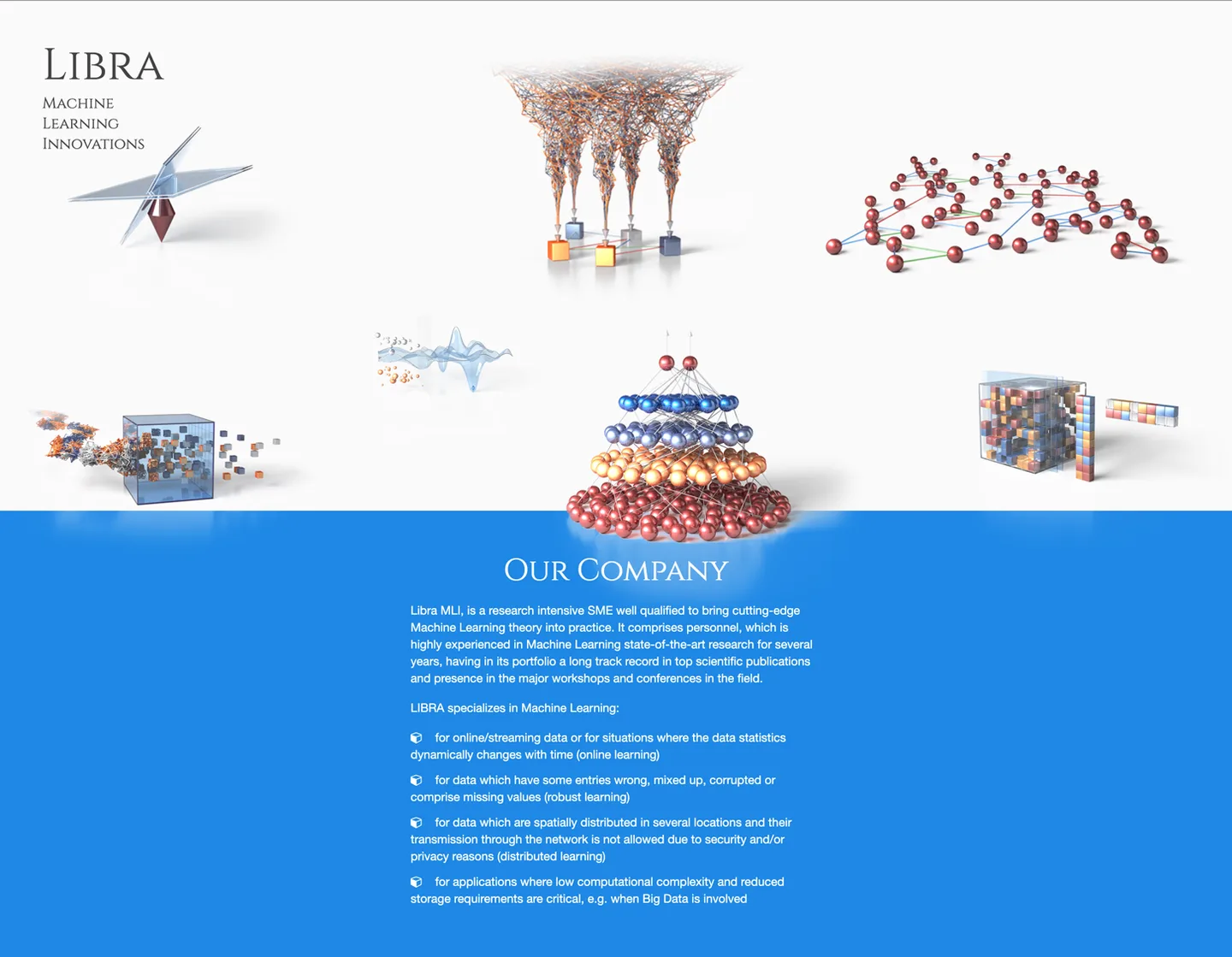 Before: accurate text, written for experts.
First, we had to understand what Libra does
If we don't understand a service ourselves, we can't turn it into images, motion and UX. Over many meetings, Libra's team, Yannis Kopsinis in particular, walked us through how each one works: Data innovation strategies, Visual data exploration, AI-enabled business intelligence, AI-powered products & projects. If that sounds like nuclear physics to you, that's about how it felt to us at the start.
Those conversations gave us one of the best ideas of the project: show, don't tell. Wherever possible, visitors don't read what Libra does, they see it on real data and "play" with it. Where an interactive demo wasn't possible, we used video, an image or an illustration.
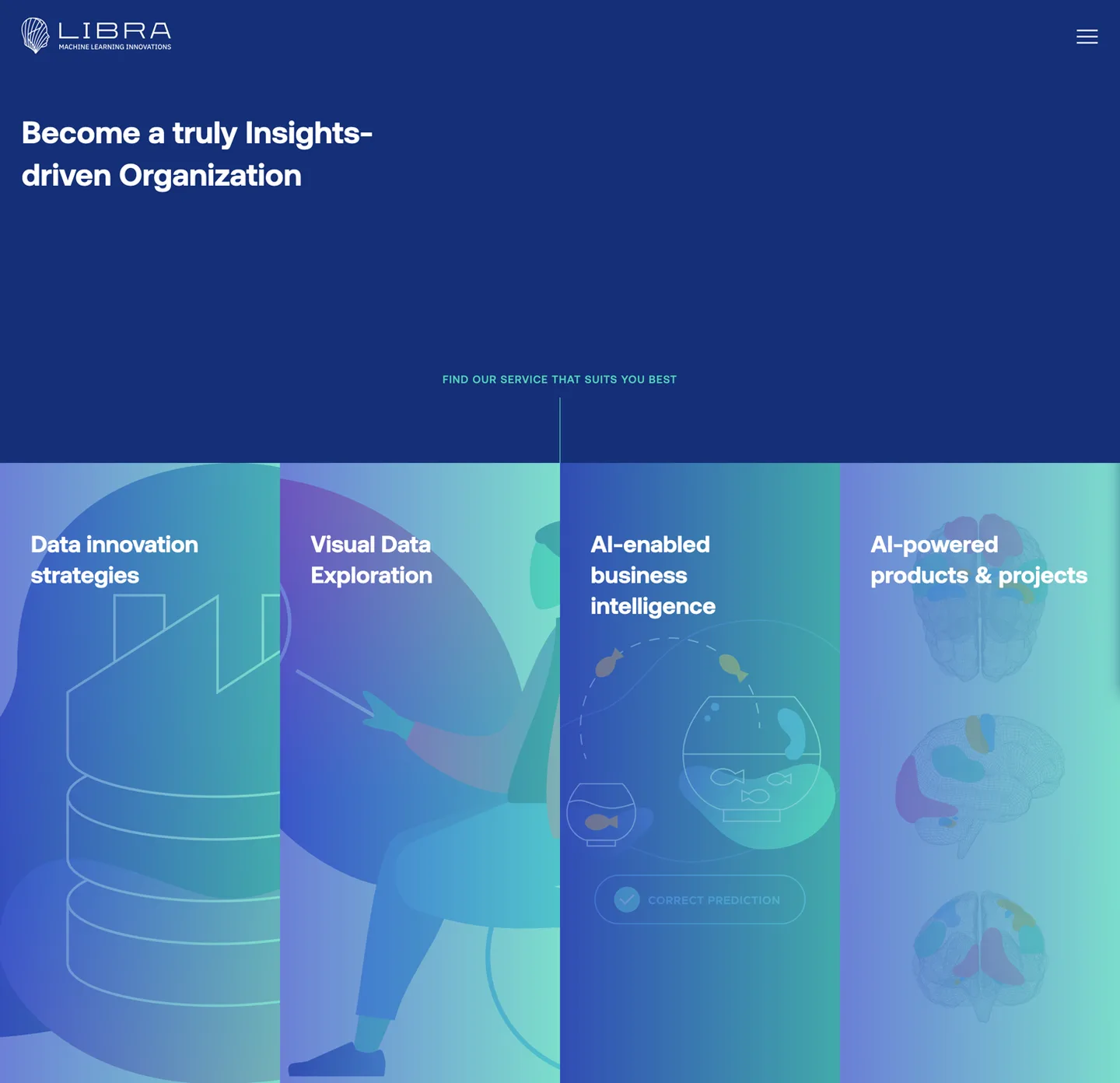 After: the four services are the first thing you see, because the whole site is built around them.
A data strategy became a story you scroll through
Each service says something different, so each got its own page, designed as its own concept. On Data innovation strategies, a scroll animation follows the path of data, from its sources to processing and analysis. It ends in two places: with a person, who uses the analysis to investigate and draw conclusions, and with AI, which makes predictions.
The whole journey ends in two answers: what happened, and what will happen.
You try the dashboard instead of reading about it
For Visual data exploration, Yannis suggested real data: hotel prices and tourist arrivals in Athens, Bangkok and Cape Town over one year. You drag across the chart to pick a period and see the average price per city straight away. The value of good data visualisation shows faster when you use it than when you read about it.
Real data: visitors picture straight away what they'd see in their own.
Six demos showed what AI can do
The most interesting page for us was AI-powered products & projects, because it didn't describe what Libra could do, it showed it, with six demos. A few of them:
Named entity recognition: natural language processing (NLP) on a recipe, where words are recognised by category.
fMRI brain networks: you see which areas of the brain light up for each activity.
And finally, Sound event detection and Object detection with computer vision: two videos made by the videographer we worked with.
Libra recently refreshed this page to show their services as they are today. So we said goodbye to one of our favourite pages, but we count it a success that it served its purpose for six years, in such a fast-paced field.
Learning Libra's work took us longer than we planned
Every answer opened new questions, so the whole process (meetings, internal workshops and so on) took far longer than we'd planned. We wouldn't change it. It was one of the most interesting parts of the project and we learned a lot, mostly thanks to Yannis: always available and kind, happy to explain something a third or fourth time. Today, though, when a client's field is this specialised, we start with a Discovery, so that time is budgeted from the start.
Six years on, Libra runs the site itself
Libra has its own engineers, so we didn't hand them a black box: they ship their changes without going through us. Over the years, without our help, some service pages have changed a lot, and many new pages and content types have been added, such as a blog and case studies. In Lucent CMS they create new content types themselves, and the design system we built keeps every addition consistent with the rest of the site.
The site runs on Laravel and our own Lucent CMS, with animations in GSAP and ScrollMagic and the dashboard in Vega-Lite.
We asked Yannis how it looks to him today, six years on:
"Radical Elements took the time to understand our work and helped us communicate it in a way businesses could relate to. They created a custom, modern and thoughtful design that goes beyond the typical tech website and reflects how we think and work. They turned complex AI concepts into a clear, interactive experience, while giving our team the freedom to develop the site as LIBRA grew. Six years on, that foundation continues to serve us well." — Yannis Kopsinis, Libra AI Technologies
If you're looking for the best way to communicate your services, let's talk.
Let's do it
Email us at [email protected]